Still thinking about learning how to code in 2025? Maybe you should read this.
There was a time when building software required years of training and a team of developers. Think 1950s mainframes, punch cards, and elite engineering degrees. But now, things have changed—and fast.
The first computer programmers were often women who previously worked as human computers. After years of manually calculating through various tasks and problems, they acquired good arithmetic skills, logical thinking, and the ability to break down complex tasks. And these were the perfect skills to have to become a programmer.
These days, it is still common for people with a science background to transition into coding jobs like software engineering or data science. The same skills are still relevant for any kind of programming.
But now that AI is getting better at coding every day… are these skills still relevant?
Is AI replacing programmers?
I hate to say this, but yes, it depends.
I started learning Python only six years ago. I already had some experience with statistical analysis in STATA and data analysis in R at school, and moving to Python syntax was less painful. Still, it took me a couple of years to feel comfortable writing and debugging Python code.
Now, AI tools generate functional code in seconds, a task that took me years to learn.
We are now seeing people shipping MVPs and delivering real results for clients using just natural language. No bootcamps. No Computer Science degrees. Just vibe-code.
That is, of course, a great trend. These AI developments shouldn’t just benefit us, developers — they should benefit everyone.
And if AI is that good… do we still need skilled engineers?
I always feel a bit conflicted when I see people shipping a vibe-coded MVP as a final product**.**
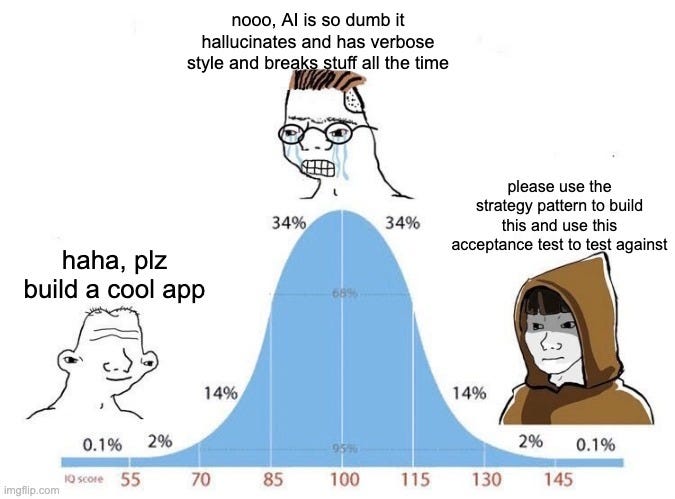
On one hand, it is genuinely exciting that people without a technical background can build working solutions in days. On the other hand, you can argue that AI-generated code is still quite fragile. It could delete important pieces of code, sometimes breaking more stuff than it actually fixed. Or, my personal biggest pet peeve, when it writes overly verbose code.
That said, for most people who use AI in their daily work, mastering the syntax is perhaps no longer the most valuable skill. The AI can handle the missing semicolons for you, but you will still need to break down the complex problems and handle the strategy, and tell the AI exactly what it should do.
You need to define requirements; vague instructions lead to back-and-forth chats that do not solve the problem. You need to design your system, the flows of data, and the components for your backend and frontend and how they are connected. You need to understand the code, be able to spot bugs, and know your way to navigate through the code base.
And at the highest level, deep technical knowledge still matters. I read that one of the reasons for Deepseek’s success was that their AI researchers and engineers not only code well, but also understand how software runs on hardware — along with the math and logic behind AI. This is not something you can fake with an AI assistant.
Is programming still a good career choice?
If you are just a regular person like me, or someone at university deciding on a career path, I highly doubt that.
Just a few years ago, if you knew Python, fundamental Machine Learning theory, and had a few portfolio projects, you were in! Everyone would beg you to work for them.
But now? Anthropic CEO Dario Amodei predicts that nearly 50% of all entry-level positions will disappear within the next five years, and we are already seeing clear signs of this shift. For example, smaller tasks that would typically go to junior developers are now being handled by AI — just tag Copilot on a GitHub issue. A report from 365datascience states that only 2.5% of all data science job ads are for junior-level positions.
So yes — it is obvious there will be fewer jobs for entry-level programmers, and probably lower average wages too.
Sure, there may still be opportunities for exceptional programmers — perhaps at top-tier tech companies in Silicon Valley — but that market is going to be so tiny.
Still, I believe everyone should learn to code, to some degree.
It is similar to calculators. While everyone has access to a calculator all the time and you don’t need to do any mental arithmetic in real life, it is still an important skill to have. Having basic coding literacy helps you understand what AI is doing. It sharpens your thinking. It helps you debug when AI gets it wrong. People who understand the language of software, even just the basics, can instruct LLMs more precisely and achieve better results.
For example, I was recently working on a project that required me to use TypeScript to build a frontend application. There are many templates out there, and there is no point in building everything from scratch. With templates and the help of AI, I got the app up and running fairly quickly.
But once I needed to add more features, things started to break. I spent hours in frustrating back-and-forth chats with the AI, trying to patch things together. Eventually, I gave up and spent a few evenings going through a TypeScript course.
Now I can actually understand the syntax, and debugging is way easier. At least I no longer feel like I’m blindly guessing my way through the code.
Or another example, instead of asking an AI to implement a feature and then testing it manually, you often get much better results by writing a test first and only then asking the AI to implement the feature, using the test as a guide.
And here is a funny paradox
As AI becomes better at coding, learning to code becomes easier. The barrier to entry is lower than ever. And for that reason, more people should learn how to code (to some degree), not fewer.
But is it still a good idea to excel at coding and build a whole career around it? I doubt that.
Unless you’re world-class — and you love it, and you are ready to compete in a talent war in Silicon Valley — then it might not be worth putting all the effort into becoming a full-time engineer.